

32,000 moving hair cells inside your inner ear send signals to your brain faster than any other system. (A. James Hudspeth, Rockefeller, U.). Viktor Zuckerkandl proves that ear logic is innate: no training necessary ("Sound and Symbol"). Pay attention!
But eye and muscle signals may get in the way, especially while playing your instrument: "Just play the right note on time!"
Whether or not you are aware of it, tone affects you as deeply as the taste of foods you do or do not like. Color can put you in touch with the taste of tones so that we can talk about them.
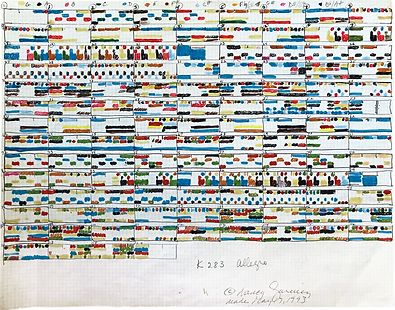
This is my very first attempt to show how I heard.
The 1st movement of Mozart's Piano Sonata in G, K. 283 had bothered me as a child, and I was about to perform it after a break of 30 years not playing solo piano. It woke me up night after night at 3 a.m. But now I could show what had so bothered me.
I Can Show You
How I Hear

Listeners heard a marked change in my playing, so I kept doing it, though at the time I had no clue what it was about. Now I see that it is all about white key vs. black key resonance, and the power of the Alberti figure.
The repeated notes of the Alberti figure affect the overtones of every piano string. Tonal Refraction makes this visible. The Alberti in
K. 283 was the subject of my 2016 presentation at an International Conference of the Society for Music Perception and Cognition (SMPC).

The second composition which I turned into a Tonal Refraction was Schumann's Waldszenen. That one called for a full palette of artist colors.
The cycle tells of a day in the woods in several different keys, B-flat, D minor, E-flat, G minor. D felt like the note binding the whole cycle. Being halfway between the first sharp and the first flat, D is open to many harmonic colors. Red seemed right for D, radiating through yellow for sharps, and through blues for flats.
Between this first Refraction (1993) and 2016, I performed the cycle many times, finding it increasingly mysterious. Eventually I realized that red was inappropriate for the organizing color/tone of this work: that it should be quite the opposite, a slate gray. My second presentation of Tonal Refraction (at a Regional conference of SMPC at Harvard University) concerned this change of heart, visible in the poster below.

By that time I had struggled to find appropriate colors for other tones which had long bothered me, most especially the opening G of the Mozart G minor Piano Quartet, K. 478, a deeply troubling work for many musicians.
Color wheels present the tones clockwise in the order in which they appear in the work, beginning at noon with the first tone. As can be seen in the chart above, sharps radiate outward from the circle, flats inward. These graphics are the contribution of designer Cathrin Hoskinson, who collaborated on the book on the Mozart Quartet Book, published in 2013. (available on store page)
Watch the finished Refraction of K. 478 synced to a recording by the Tonal Refraction Ensemble here.

